Evaluating 3D Icon Business and Finance for Modern Digital Projects
In the rapidly evolving landscape of digital design, visual assets play a pivotal role in conveying complex information quickly and effectively. Among the various categories of graphical elements, 3D Icon Business and Finance has emerged as a critical component for professionals seeking to modernize their user interfaces and marketing materials. These assets are not merely decorative; they serve as functional signposts that guide users through financial dashboards, corporate websites, and mobile applications. Understanding the specific attributes of this asset class is essential for designers, product managers, and business owners who need to make informed decisions about their visual identity.
The core value of 3D Icon Business and Finance lies in its ability to add depth and realism to abstract concepts. Unlike traditional flat icons, which rely on minimalism and two-dimensional shapes, 3D representations utilize lighting, shadow, and texture to create objects that appear tangible. This distinct characteristic makes them particularly effective for financial themes where trust, stability, and precision are paramount. When a user interacts with a dashboard displaying growth charts or security protocols, high-quality 3D visuals can subconsciously reinforce the perception of robustness and reliability.
Distinguishing Features and Technical Specifications
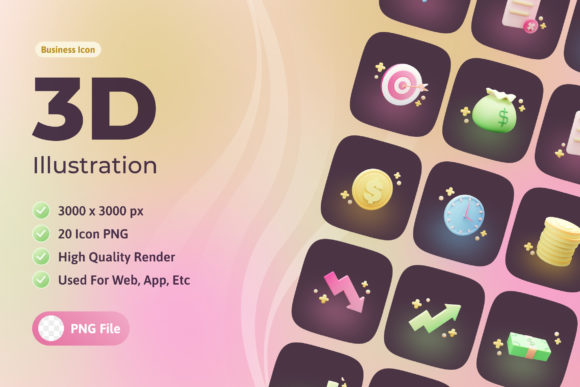
When evaluating a set of 3D Icon Business and Finance, it is crucial to look beyond the aesthetic appeal and examine the technical specifications that determine usability. A premium collection typically includes 20 unique designs, each crafted to represent specific aspects of the corporate world, such as data analysis, investment strategies, banking transactions, and global commerce. The distinctiveness of these icons often stems from their attention to detail and the consistency of their style across the entire set.
One of the primary advantages of utilizing a dedicated 3D icon pack is the resolution and scalability provided. High-resolution assets, specifically those rendered at 3000 x 3000 pixels, ensure that graphics remain crisp and clear regardless of the display density. This level of detail is vital for Retina displays and high-DPI monitors, which are standard in professional environments today. Furthermore, the inclusion of a transparent .png background eliminates the need for time-consuming manual editing. Designers can instantly drop these icons into their workflows without worrying about white boxes or jagged edges that compromise the final output.
The "ready-to-use" nature of these assets significantly reduces production time. Instead of spending hours modeling individual elements in 3D software like Blender or Cinema 4D, teams can leverage pre-rendered, full-color icons that adhere to a cohesive color palette. This efficiency allows creative teams to focus on the broader strategy of UI/UX design rather than getting bogged down in the minutiae of asset creation.
Comparing 3D Styles with Flat and Isometric Approaches
To make an informed decision, it is necessary to understand how 3D Icon Business and Finance compares to other popular design styles, such as flat design and isometric illustrations. Each approach offers unique benefits depending on the context of the project.
Flat Design: Historically, flat design dominated the web due to its clean lines and fast loading times. While still relevant for minimalist interfaces, flat icons can sometimes struggle to convey complex hierarchies or emotional weight. In the finance sector, where clarity is key, flat icons might appear too simple for certain advanced features. However, for basic navigation menus, flat icons remain a lightweight and efficient choice.
Isometric Illustrations: Isometric art uses a specific type of parallel projection to create a 3D effect without perspective distortion. It is widely used in infographics and architectural diagrams. While isometric icons offer a structured look, they can feel rigid and geometric compared to the organic, polished finish of true 3D rendering. 3D Icon Business and Finance sets itself apart by offering more realistic textures and dynamic lighting that mimic real-world objects, providing a sense of luxury and sophistication that is often missing in isometric styles.
The tradeoff between these styles often comes down to performance versus impact. Flat icons load faster and consume less bandwidth, making them ideal for low-bandwidth environments or massive data tables. In contrast, 3D icons demand more processing power but deliver superior visual engagement. For high-end fintech apps, landing pages, and investor presentations, the visual impact of 3D assets usually justifies the slight increase in file size.
Ideal Use Cases and Strategic Applications
Identifying the right moment to deploy 3D Icon Business and Finance requires analyzing the specific goals of the project. These assets excel in scenarios where differentiation and brand personality are priorities. For instance, in mobile app development, 3D icons can transform a generic financial tool into a distinctive product. Users scrolling through an app store are more likely to engage with an interface that feels immersive and modern.
Web infographics are another area where these icons shine. Financial reports often involve dense data that can be overwhelming to read. By integrating 3D visuals to represent metrics like revenue growth, market share, or risk assessment, designers can break up text-heavy content and make statistics more digestible. The transparency and high resolution of the .png files ensure that these graphics integrate seamlessly into complex layouts without clashing with backgrounds.
Additionally, these icons are highly effective for UI/UX design when creating onboarding flows or feature highlights. When a user first encounters a new financial service, the initial impression matters. A well-crafted 3D icon can immediately communicate the function of a button or section, reducing cognitive load and improving the overall user experience. The tactile quality of 3D objects helps users intuitively understand interactions, leading to higher conversion rates and better retention.
Evaluating Limitations and Decision Factors
While the benefits of 3D Icon Business and Finance are substantial, they are not a universal solution for every design challenge. One significant limitation is the potential for visual clutter. If overused, the richness of 3D graphics can distract from the primary content, especially in data-dense environments like trading platforms or accounting software. In such cases, a more subdued, flat, or line-based iconography might be preferable to maintain readability and focus.
Another consideration is the cost and accessibility of implementation. Creating or acquiring high-quality 3D assets often involves a higher budget compared to purchasing vector packs. Furthermore, if the design system needs to support multiple themes (such as dark mode), ensuring that 3D icons render correctly across different color schemes requires careful testing. The fixed lighting and shading in pre-rendered .png files may not adapt dynamically to background changes, potentially requiring alternative versions for different contexts.
When deciding whether to proceed with this option, stakeholders should weigh the target audience's expectations. Younger demographics accustomed to modern gaming and social media aesthetics may respond positively to the immersive nature of 3D icons. Conversely, a conservative enterprise client might prefer a more traditional, understated look. The decision ultimately rests on aligning the visual language with the brand's voice and the specific functional requirements of the platform.
Maximizing Value Through Integration
To get the most out of a collection of 20 unique 3D icons, integration must be strategic. Rather than using them as standalone decorations, designers should treat them as integral parts of the information architecture. For example, using a 3D coin icon to represent currency exchange, a 3D chart to denote analytics, and a 3D shield for security creates a narrative flow that guides the user through the application.
The versatility of these assets extends beyond static images. With high-resolution sources, designers can extract layers or use the images as references for creating motion graphics. Adding subtle animations to 3D icons—such as a gentle rotation or a pulsing glow—can further enhance user engagement without compromising performance. This flexibility makes 3D Icon Business and Finance a valuable resource for long-term branding efforts, allowing for consistent evolution across web, mobile, and print media.
Ultimately, the choice to adopt 3D Icon Business and Finance depends on a balance between aesthetic ambition and practical utility. For projects aiming to stand out in a crowded marketplace, these icons provide a competitive edge through their premium quality and distinct visual language. However, success relies on thoughtful application, ensuring that the added depth serves the user's needs rather than overshadowing the content. By carefully evaluating the strengths and limitations discussed, teams can make confident decisions that elevate their digital products to the next level.