Isometric 3D Online Shopping: Elevating Digital Commerce
In the rapidly evolving landscape of digital marketing, visual communication has become the primary language through which brands connect with their audience. Among the myriad of design trends that have emerged to capture attention, Isometric 3D Online Shopping stands out as a particularly effective and versatile tool. This style is not merely a fleeting aesthetic choice; it represents a fundamental shift in how we visualize complex data, products, and services on flat screens. By combining the depth perception of three-dimensional space with the structured precision of two-dimensional geometry, designers can create environments that are both engaging and easy to understand.
This article explores the utility of this specific illustration style, examining why an isometric illustration of a 3D shopping environment might be the perfect asset for your next project. Whether you are a business owner looking to revamp your e-commerce platform or a creator seeking high-quality assets for a marketplace project, understanding the nuances of this design approach is essential.
Understanding the Isometric Perspective
To appreciate the value of Isometric 3D Online Shopping, one must first understand what makes it unique compared to other forms of 3D rendering. Unlike perspective drawing, where parallel lines converge at a vanishing point to simulate human vision, isometric projection maintains parallel lines throughout the image. This creates a consistent scale across the entire scene, ensuring that objects do not appear distorted based on their distance from the viewer.
This geometric consistency offers several practical advantages for online commerce:
- Clarity and Readability: Because there is no distortion, product sizes remain visually accurate relative to one another. This helps users mentally calculate dimensions without needing to guess.
- Aesthetic Appeal: The clean, grid-based look provides a modern, organized feel that reduces visual clutter, allowing key information to stand out.
- Scalability: These illustrations are often vector-based, meaning they can be resized from a small mobile icon to a massive billboard without losing quality.
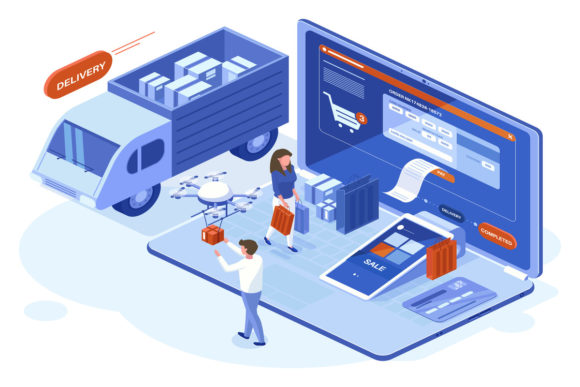
When applied to the context of online shopping, these features transform a static webpage into an interactive-looking experience. An isometric illustration of a 3D shopping environment acts as a virtual storefront, guiding the user's eye naturally through the layout and highlighting specific categories or promotions.
The Strategic Value for E-Commerce and Marketing
Why should professionals invest time and resources into incorporating Isometric 3D Online Shopping visuals? The answer lies in the psychological impact of the imagery. Human brains are wired to respond to spatial cues. When a user encounters a flat, 2D list of products, the experience is functional but often forgettable. However, when presented with a stylized 3D environment, the brain engages more deeply, interpreting the scene as a place to explore rather than just a list to scan.
This engagement translates directly into higher conversion rates and better brand retention. For instance, a landing page featuring an isometric illustration of a 3D shopping environment can effectively demonstrate the flow of a customer journey. You can visualize a customer picking up a product, adding it to a cart, and checking out, all within a single, cohesive graphic. This narrative capability is difficult to achieve with standard photography alone.
Key Applications Across Industries
The versatility of this design style means it is not limited to a single sector. While the name suggests general retail, the applications are far broader:
- E-Commerce Platforms: Online stores use these graphics to create custom "About Us" pages, feature new arrivals, or explain complex return policies in a visually digestible format.
- SaaS and Tech Products: Software companies often use isometric art to visualize abstract concepts like cloud storage, data security, or network connectivity, making technical services feel tangible.
- Marketplace Projects: For platforms connecting buyers and sellers, an isometric illustration of a 3D shopping environment serves as a welcoming hub, symbolizing the variety and abundance of goods available.
- Marketing Campaigns: Email newsletters, social media ads, and blog headers benefit greatly from the high click-through potential of 3D isometric designs.
Practical Considerations for Implementation
While the benefits are clear, integrating Isometric 3D Online Shopping assets requires thoughtful planning. It is important to distinguish between using a ready-made asset and commissioning a custom design. Many creators rely on pre-packaged files, such as those containing a One EPS10 file and a 72ppi Resolution JPEG as a preview.
Understanding File Formats:
The inclusion of an EPS10 file is crucial for professional workflows. EPS (Encapsulated PostScript) is a vector format, which means the artwork is defined by mathematical equations rather than pixels. This allows designers to scale the isometric illustration of a 3D shopping environment to any size without pixelation. Whether you need a tiny favicon or a full-screen background, the vector source ensures crisp edges and sharp details.
Conversely, the 72ppi Resolution JPEG serves as a convenient preview. In web contexts, 72 pixels per inch is the standard resolution for screen display. This file type is lightweight and loads quickly, making it ideal for initial mockups or direct use on websites where file size optimization is a priority. However, relying solely on the JPEG for print materials would result in poor quality, highlighting the importance of having access to the vector source.
Strengths and Limitations
Every design choice comes with trade-offs. The primary strength of Isometric 3D Online Shopping is its ability to convey structure and organization. It works exceptionally well for infographics, floor plans, and process flows. Furthermore, because the style is stylized rather than photorealistic, it avoids the uncanny valley effect that sometimes plagues 3D character models, keeping the focus on the content.
However, there are limitations to consider. Isometric art can sometimes lack the emotional warmth of real photography. If a brand relies heavily on the texture and tactile feel of physical products (like luxury fabrics or food), a purely geometric illustration might feel too sterile. Additionally, while the style is timeless, it does require a certain level of design literacy to implement correctly. Poorly constructed isometric scenes can look confusing or disjointed if the lighting and shadows are inconsistent.
Evaluating Suitability for Your Project
Before selecting an asset or hiring a designer, ask yourself specific questions to determine if Isometric 3D Online Shopping aligns with your goals. Are you trying to simplify a complex process? Do you need to guide users through a specific path? Is your brand identity modern and tech-forward?
If the answer is yes, then an isometric illustration of a 3D shopping environment is likely a strong candidate. It provides a scaffold upon which you can build your narrative. For example, a startup launching a new app could use the illustration to show how different features interact within the app interface. A logistics company could use it to map out supply chain routes.
When evaluating a specific product, such as a package containing a One EPS10 file and a 72ppi Resolution JPEG, check the following:
- Customizability: Can the colors be easily changed to match your brand guidelines? Vector files usually allow this, but some flattened assets may not.
- Detail Level: Does the illustration contain enough detail to hold interest, or is it too simple to convey your message?
- Context: Does the scene make sense for your industry? A generic shopping cart might work for retail, but a specialized warehouse scene might be needed for B2B logistics.
Conclusion
In conclusion, Isometric 3D Online Shopping represents a powerful intersection of art and utility. It transforms the mundane act of browsing the internet into an immersive experience, providing clarity, engagement, and a distinct visual identity. By leveraging the strengths of vector formats like EPS10 and understanding the appropriate use of 72ppi Resolution JPEG previews, creators can maximize the impact of their visual assets.
Whether you are designing a new e-commerce site, creating a marketing campaign, or simply looking to refresh your digital presence, incorporating an isometric illustration of a 3D shopping environment can set your project apart. It is a testament to the fact that in the digital age, how something looks is just as important as what it says. By choosing the right tools and understanding the principles behind this design style, you can ensure your message resonates clearly and effectively with your audience.
As you move forward with your projects, remember that the goal is not just to decorate, but to communicate. Use these visual elements to tell your story, guide your users, and build trust. The future of online interaction is visual, and Isometric 3D Online Shopping is leading the way.